


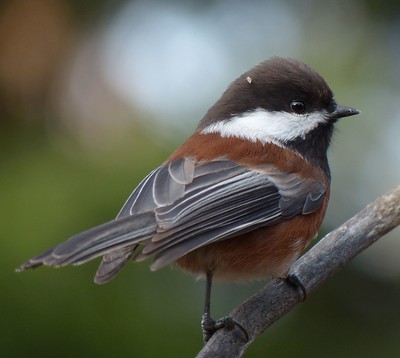
Chestnut-backed Chickadee was one of the species that exhibited two peaks in acoustic activity over the course of the breeding season. Photo by Eugene Beckes.
Birds, in general, are noisy. Sound is one of the primary ways they communicate, and the noises they make contain a lot of information. Bird biologists, and anyone who pays attention to birds, for that matter, understand that the sounds a bird makes are full of clues about its biology beyond just the fact that it is present. Its age or sex, whether it has a mate, what stage of courtship it’s in, how often it has to counter-sing with nearby territory-holders to maintain its status, and more, are potentially decipherable by listening carefully. If you listen carefully to enough individual birds, you can see population-level patterns that tell us how birds are interacting with the landscape.
In the past decade or so, as autonomous recording units (ARUs) became more affordable, their use in field ecology took off. Rather than having a biologist hiking out in the field and listening with datasheet in hand, these devices could be placed in the field and programmed to record for months on end- a method termed passive acoustic monitoring (PAM.) PAM increased the amount of acoustic information that could be captured by scientists by orders of magnitude, but the volume of information created challenges of its own.
Because many ARUs can be deployed at one time and can record for so long, thousands hours of recordings may be collected-so many that it could take a human literal years of 24/7 listening to go through and ID bird sounds on these recordings. Advances in AI, specifically machine learning, now allow computers to “listen” for us. BirdNET, a machine-learning model built by Cornell University and Chemnitz University of Technology, essentially trains a computer to recognize the pattern of a bird sound allowing the computer to quickly scan through a recording flagging that pattern.
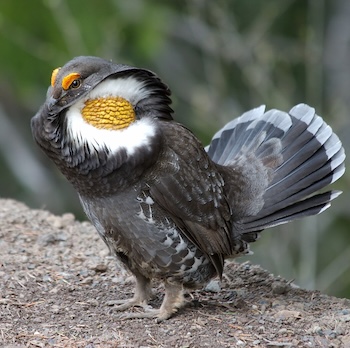
A Sooty Grouse's drumming is an example of an important non-vocal sound. It is also one of the species that exhibited a single peak in acoustic acitivity during the breeding season. Photo by Patrick/Flickr.
In addition to their length in hours, datasets collected by PAM are massive in terms of file size. They are measured in terabytes (1,024 GB), 2-4 times the size of an average laptop’s hard drive, or petabytes (over 1 million GB), which are harder to grasp but roughly the equivalent of 133 million digital photos. Datasets this size poses significant computing challenges in terms of storage and management. They also require different analysis techniques. Because the data is collected and “listened” to in different ways than a traditional human observer study, it has different types of errors and biases that must be accounted for in statistical analyses. Thus far, PAM has primarily been used to answer questions in population biology such as the presence of a species (occupancy), and in a few cases, its abundance. But PAM has potential to answer other types of bird ecology questions if methodological hurdles involving recording, data processing, and analysis can be overcome.
In a study published this month in the journal Ecology and Evolution, IBP Acoustic Avian Biologist Dr. Mary Clapp, along with scientists from IBP, UCLA, the US Forest Service, and the National Park Service, examined recordings from ARUs deployed during the breeding season in Olympic National Park. The goal of the study was to propose a method for combining PAM data and AI classification models to quantify acoustic phenology, or the timing of birds’ sounds over the breeding season. The paper details methods for processing and analyzing PAM data to answer questions about sonic behavior. The term “sonic behavior” encompasses non-song vocalizations, like alarm calls, as well as non-vocal sounds like woodpecker or grouse drumming. Clapp explains the significance of phenology:
"Phenology is important because timing is everything when it comes to tracking the resources animals need to survive. Mutualisms that structure entire ecosystems, such as the ones shared by hummingbirds and flowering plants, or nutcrackers and pine seeds, are maintained by the fact that mutualists find each other at the right stage in their life cycles year after year. It is critical to conservation science to understand how robust or vulnerable such synchronies are to environmental changes (such as climatic conditions, land use), and describing animals’ phenological patterns allows us to do that. Because PAM data often represents a nearly continuous measure of sonic activity, it is perfectly suited for describing the phenology of sound-producing organisms—not just as a single start date or peak of a certain behavior, but as an entire seasonal distribution. However, there are significant challenges to processing acoustic data, and specifically in interpreting the outputs of AI classifiers like BirdNET, that need to be addressed for us to be confident that we are producing reliable estimates of sonic behavior."
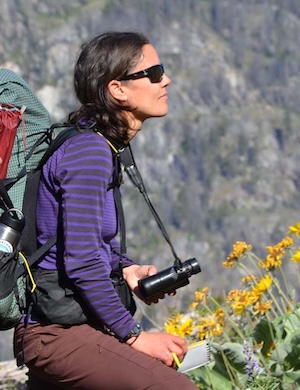
IBP Biologist Mandy Holmgren has been monitoring birds by sight and sound in the Pacific Northwest for two decades. Photo by Chris Ray.
The dataset in this study consisted of 18,568 hours of PAM audio recorded at 185 recording sites across Olympic National Park in the spring and summer of 2021. These recordings were originally made as part of an owl survey, but since they included sounds made by all types of birds, not just owls, the researchers leveraged them to address their questions about phenology in multiple species. They ran the recordings through AudioDash, a cloud-hosted system, developed by IBP in partnership with software developer Joe Weiss of Tungite Labs. AudioDash uses BirdNET to classify bird species within large amounts of audio data, organizes and stores those results, and provides a web browser interface for reviewing particular subsets of identified recordings. This process generated roughly 10 million 3-second snippets of recording, each with an associated identification and confidence score. Next, the researchers leveraged the considerable local experience of several IBP field biologists, including co-author Mandy Holmgren, to validate the acoustic data by manually reviewing a subset of samples from each species. Those expert verifications were critical to quantifying BirdNET performance and filtering the dataset to only include identifications with very high accuracy.

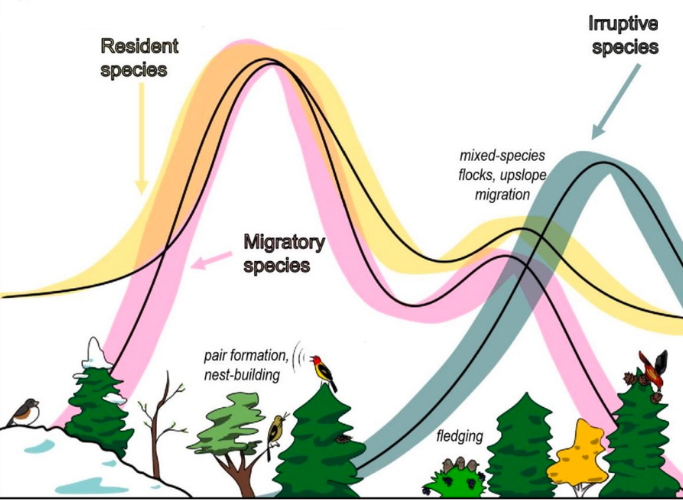
Figure 1a from Clapp et al 2026. "The vocal activity of individual birds of a species in a region can be summarized by a cumulative function or mean, which represents population-level vocal phenology, and variance that represents individual variation in individual activity. Metrics of the population-level phenological distribution, “phenometrics”, can be calculated and compared across species, regions, or years."
Clapp and co-authors then used a statistical method called hierarchical generalized additive modeling (HGAMs) to estimate daily probabilities of vocal activity for 25 bird species representing diverse migratory strategies across both low and mid elevations of the Park, and derived “phenometrics” that described the timing, duration, and shape of vocal activity curves. They used these phenometrics to test three hypotheses about the phenology of bird sonic activity: (1) acoustic activity peaks in the late spring and early summer when birds are establishing territories and attracting mates; (2) resident species are more likely to vocalize in breeding locations in the pre-breeding season, while acoustic activity periods of migratory species will be more truncated by their arrival and departure dates; (3) vocalization frequency peaks later and is shorter overall at higher elevations.

Figure 1b from Clapp et al 2026. "Phenological distributions can also be evaluated along environmental gradients, such as elevation."
Those hypotheses might seem familiar, or even common knowledge. Each one is well supported by other studies using more traditional methods, and that is by design. Just like BirdNET identifications need to be validated by human ears and brains, new methods need to be validated by using questions for which you already have a good answer. This is kind of like studying for a test on multistep algebra problems- you want to do some practice problems where you know the answer so that you can be sure you’re the going through the steps correctly.
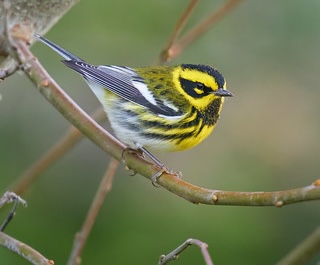
Townsend's Warblers are long distantance migrants which exhibited a shorter period of acoustic activity than many resident bird species. Photo by Grigory Heaton.
Clapp and coauthors found that their PAM data and analyses did indeed support the three hypotheses. They found that about half of the species in the study had a single peak in acoustic activity over the course of the breeding season, while a little over a third of species had a peak later in the breeding season in addition to the first one. A few remaining species didn't have discernable peaks in their acoustic activity, though this is largely due to an insufficient sample size. The models showed that long-distance migrant species increased their vocalization frequency later in the spring compared to resident species and some short-distant migrant species. In addition, the period of increased sonic behavior was longest in residents, moderate in short-distance migrants, and shortest in long-distance migrants. Peaks in sonic behavior of a given species occurred 17 days later, on average, at mid-elevations than at low-elevations.
The researchers lay out their methods for recording, data processing, and analysis in detail in the paper so that other researchers can use these validated methods to design new PAM studies or use existing PAM datasets to tackle questions in phenology. Clapp discusses some of the questions this study generated, as well as some other questions that might be answered using these methods:
"While we found support for our most basic hypotheses, we also identified several open questions. For instance, we found a second peak in sonic behavior later in the breeding season in many species, but we don’t know for sure what kinds of behaviors are associated with these secondary peaks in sound making. Are they related to second clutches? The formation of mixed flocks in the fall? To answer those questions, we need to use on-the-ground field ecology techniques to connect some of these less-well described periods in birds’ lives with their sonic signatures.
Combined with advances to classifier technology (like the ability to train classifiers that identify different sound types within species), we will be able to move toward a better understanding of birds’ sounds across their entire annual cycle, not only within their breeding period. We also have much to learn about birds with different life histories than those that fall into “males sing and defend territories” paradigm common to North America. This method could be applied to species and areas where female song is more prevalent, across biomes and latitudes, and across species’ breeding ranges. Over time, we hope it is used to track how vocal phenology changes over time, and combined with other measures of phenology, such as seasonal vegetation green-up."
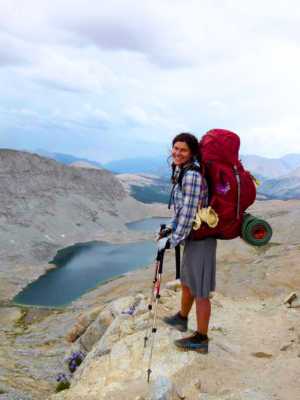
Dr. Mary Clapp doing fieldwork in the Sierra Nevada in California. Photo by Rachel Friesen.
PAM combined with AI classifiers has the potential help scientists answer many questions about bird ecology. It will not, however, replace boots on the ground field ecology. Human observers can gather more information about context, behaviors associated with sounds, and atypical sounds and behaviors that an automated recorder and AI cannot. Still, PAM can greatly expand the scale at which we can monitor bird sounds, its longer recording times increase the ability to detect rare species and, in the case of sensitive species, it can be less intrusive than human observers. Additionally, PAM produces an enduring record of an entire season of acoustic activity, rather than a snapshot in time. Clapp believes methods that rely on technology, like PAM, are best used in combination with methods using human observers in the natural environment.
"Developing our technological literacy to accommodate these data types is worth celebrating, but it need not be an exchange for our ecological literacy. I think IBP marries the two really well. The hours we spend out in the field develop fundamental skills in observation and familiarity with our study systems, not to mention passion for understanding and conserving them. These experiences are the bedrock of ecological thinking- they are what engender good questions and what allow us to design robust studies in the first place."