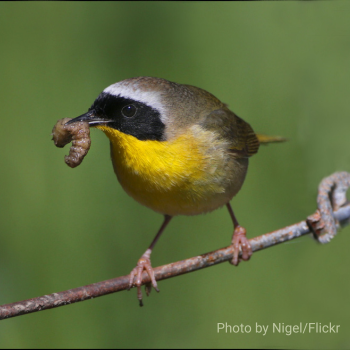



We know less about female birds than males. Why? Male birds are more conspicuous- in most species, males have showier colors, perform courtship displays, and sing more frequently. This makes them easier to study using many traditional field ornithology techniques which rely on observing birds at a distance by sight and sound. But the probability of detecting males vs females when mist-netting is likely more equitable. A mist-net catches quiet and camouflaged birds just as easily as birds that are loud and flashy.

A female Mourning Warbler, one of the species with significantly lower female survival. Photo by Allison Gregor.
A new study out in the journal Proceedings of the Royal Society, B used data from the Monitoring Avian Productivity and Survivorship (MAPS) program, which monitors bird populations using mist-netting and banding, to explore differences in survival between female and male birds. The study, titled Female North American passerine birds have lower apparent survival than males, was led by Joanna Wu, a graduate student at UCLA and former IBP biologist, and coauthored by IBP Research Ecologist Jim Saracco, Montague Clegg of UCLA, and IBP Research Associate and UCLA Professor Morgan Tingley. The researchers used well over 500,000 capture records from 92 bird species, representing 17 different families.
Wu and coauthors found that females had lower apparent survival than males in 82 of the 92 species studied and this difference was statistically significant in 35 species. In contrast, in the 10 species where female apparent survival was higher than that of males, none of these differences was significant. When all 92 species were considered together, apparent survival was more than 12% lower in females than males. “Put another way,” says Wu, “once birds reach adulthood, females live approximately 1.36 years and males 1.61 years.”
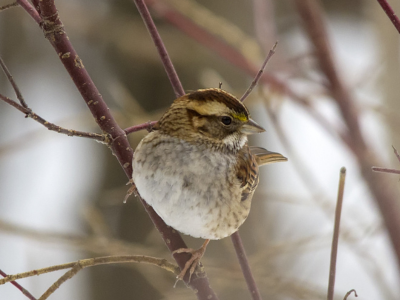
White-throated Sparrows also showed male-biased survival. Photo by Daniel Arndt.
Estimating survival in wild animals is challenging. Unless you can identify individuals from a distance (e.g., using unique patterns on the tails of humpback whales) you need to capture and mark them, then recapture or resight some of them across multiple years, which is laborious. Even then you can generally only calculate “apparent survival,” not true survival, because it’s often impossible to know for certain that an animal has died, not simply left the study area. Unless your study animal is immobile (e.g., an adult barnacle, sea sponge, etc.) or you’ve been tracking it continuously and located its body- you can’t be 100% certain. So scientists often use “apparent survival” which is the probability of true survival x the probability the animal remained in/returns to the study area. To calculate a reasonably confident estimate of apparent survival from bird-banding data, you need a large sample size of marked and recaptured individuals. And if you are trying to compare survival rates between males and females, you will need to double that sample size to generate separate estimates for each sex. This is why most estimates of apparent survival for bird species lump both sexes together, and many of them only use data from a single, intensively studied population of a species.
This is where the MAPS program comes in. In 1989, IBP founder Dr. David DeSante saw the need for better demographic data (i.e., productivity and survivorship) to monitor bird populations, so he developed a standardized bird banding protocol. This standardization allowed data collected by different banders across North America to be collected in a large database that could be leveraged to understand variation in demographic rates across species, space, and time to aid in bird conservation. Today, almost 4 decades later, hundreds of bird banding stations have used the MAPS protocol and contributed over 2.75 million individual bird capture records.

MAPS banders at the Rice Creek Bird Observatory in Upstate New York. Photo by Daniel Baldassarre.
Banding a bird is like throwing a needle in a haystack. The vast majority of birds captured at mist-netting stations are never recaptured after the occasion on which they were banded. This is particularly true of birds banded during their migration because these birds seldom use the same exact sites between years when they are on the move. One key feature of the MAPS program is that it targets the breeding season when birds of many species return to the same places to breed year after year, providing repeated opportunities to recapture birds. Think of it like trying calculate survival in humans passing through an interstate rest stop vs. those living in a residential neighborhood. So recaptures occur more frequently in the MAPS dataset.
Even so, MAPS stations catch plenty of birds that are just passing through because migration timelines vary between species and individuals. The mathematical models often used to estimate survival cannot tell the difference between a White-crowned Sparrow that died and one that stopped briefly near the banding station then moved upslope to breed at higher elevation. To get a better estimate of survival, Wu and colleagues first sorted resident from transient birds by incorporating information on whether each bird was captured multiple times during their initial year of capture (residents) or not (either transients or residents only captured once). This helped to weed out migrants and other transient individuals just passing through the study areas.
Wu says that the MAPS dataset was invaluable for this study:
MAPS allowed us to conduct this analysis using 563,414 uniquely banded adult birds. Even so, only 92 species across 17 families ultimately met the rigor of the data requirements to be modelled… We couldn’t have done this study without the work of MAPS banders, many of whom are volunteers who wake up in the wee hours of the morning (and night!) to get to banding sites, carefully handle the birds, and record the data that make studies like this possible.
Different sexes often have different survival rates- in other words there is “sex-biased” survival. In many mammals, including humans, females tend to survive longer. In studies of sex-biased survival in bird species, males seem to survive longer. But why would the sexes differ? There are 4 main hypotheses: 1. The heterogametic sex (see below) is more vulnerable to deleterious genetic mutations, 2. Movement costs reduce survival- in some species males and females migrate different distances, or one sex disperses more. 3. Reproductive costs- the sex that invests more energy and time into reproduction faces a reduction in survival, 4. Social dominance- if one sex dominates the other they may have increased survival due to better access to resources like food or shelter.

A female Wilson's Warbler. Photo by Andy Reago and Chrissy McClarren.
Heterogametic sex refers to the sex that has two different sex chromosomes. In mammals, males are the heterogametic sex; for instance, most human males have one X chromosome and one Y chromosome. But in birds females are heterogametic, they have one Z sex chromosome and one W sex chromosome (males are ZZ). The idea is that the heterogametic sex only has one copy of larger sex chromosome that has more genes (Z in birds and X in mammals) so if there is a disadvantageous mutation in gene A on that chromosome, they are stuck with it. Male birds, with two Z chromosomes, have an additional, possibly functional, copy of gene A on their other Z chromosome. This study obviously could not test this hypothesis because females are the heterogametic sex in all bird species. But other studies that looked across animal groups with different heterogametic sexes found that in general the heterogametic sex does tend to have lower survival.
Wu and colleagues were able to test the other three hypotheses across bird species using proxy variables. While they could not directly measure miles flown, energy expended on egg production, or male-female conflict over food resources for every species in this study, they were able to gather data on variables associated with those traits from resources like the MAPS database or other multi-species data sources, like AVONET. To evaluate the survival costs of movement, they considered migration tendency (non-migrant, partial migrant, or long-distance migrant), wing shape (longer and pointier-winged species tend to travel longer distances than rounder-winged species), and sex-based differences in wing-to-mass ratios. For reproductive costs they considered average clutch size and egg load, which measures the weight of a clutch of eggs relative to the female’s mass. Finally for social dominance they considered 4 variables: average mass of the species, sex differences in body mass, sex differences in average body fat scores, and sexual size dimorphism.
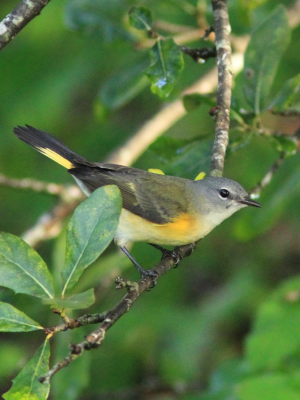
A female American Redstart. Photo by Kenneth Cole Schneider.
The researchers plugged all 9 of these proxy variables into a statistical model to determine which variables best explained differences in survival between female and male birds. They found that wing shape, migration tendency, and body fat differences were most important, supporting the movement cost and social dominance hypotheses, but not the reproductive cost hypothesis.
Female birds pay a higher survival cost in long-distance migrant species than do males- but why? In some species, females actually migrate a longer distance than males and spend the non-breeding season father south. Even when males and females are in the same area, they may use different habitats. In some species of warblers, studies have shown that females tend to be found in poorer quality habitat than males during the non-breeding season which could impact their ability to find food, etc. Wu and coauthors note that even though many North American birds spend the majority of their year on their non-breeding grounds in Central and South America and the Caribbean, they have been studied much less extensively during this period in their life history compared to the breeding season. Understanding their ecology and differences between males and females during the non-breeding season is important for conservation efforts.

A female Golden-winged Warbler. Photo by Andy Reago and Chrissy McClarren.
The relationship between survival and wing shape was more complex. The authors had predicted that bird species with longer, pointier wings would have lower female survival relative to males because these traits are generally associated with longer-distance flight, but the opposite was true- species with shorter, rounder wings had had greater male-biased survival. Wu and colleagues suggest that wing-shape may have a synergistic effect with migration distance: a long distance migration with wings that are efficient at long-distance flight is not as costly as the same migration with shorter, rounder wings that, while more maneuverable, are less efficient for long flights. If females in a species with more rounded wings are flying farther, they may thus incur survival costs.
The study found that in species where males had a relatively higher fat score during the breeding season than females, males survived longer than females. While this suggests support for the social dominance hypothesis, it’s tricky to interpret. Higher fat in males could be a holdover effect from the non-breeding season if males push females into lower quality habitat and males start off the breeding season with more fat stores, which would support the hypothesis. But females may have lower body fat than males during the breeding season because they are producing eggs which is very energetically demanding. In this study, body fat is just a proxy variable for social dominance. Wu and colleagues suggest future studies of sex-biased survival using more direct measures of social dominance might yield different results.
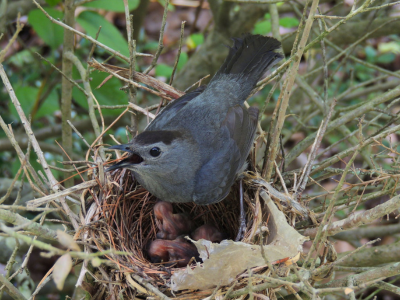
A female Gray Catbird is disturbed while brooding her nestlings. Photo by Raincrow/Flickr.
The lack of support for the reproductive cost hypothesis may be surprising; intuitively it makes sense that females, who produce large, energetically costly eggs and, in the case of most passerines, do most of the nest building and incubation, would pay the biggest reproductive cost at the expense of their survival. But this is not the first study to find a lack of support for the reproductive cost hypothesis. Female passerines certainly bear the brunt of the reproductive cost before hatching, but after hatching, feeding and nest defense are fairly equally divided between males and females in most passerines. Perhaps the post-hatching period is the most costly and this somewhat evens out costs between the sexes. Or, maybe there was not enough variation in reproductive cost among the species in this study- mostly socially monogamous passerine species- for the effect to be evident in the model. As with most things in biology- it’s complicated. But the fact that there was also no evidence for higher clutch size or egg load reducing females survival suggests that reproductive costs are not driving lower female survival.
This study documents a widespread trend of lower survival rates of female North American Passerines relative to males, but what does this mean for bird conservation? Sex-biased survival can lead to unbalanced sex ratios of reproductively active females to males. In fact, other studies have documented male-biased sex ratios in most of the species in this study. Male-biased sex ratios can limit the productivity of a population because at a very basic physiological level, eggs are costly to produce and females can only produce so many, whereas males produce an overabundance of sperm. Understanding the differences in female and male survival rates can make conservation more effective. Wu elaborates:
Beyond documenting a widespread pattern in North American passerines, our findings have important implications for conservation. In an era of massive environmental change, managers need to make strategic use of limited resources to help populations persist. Because survival differed substantially between female and male birds, we suggest that population studies should consider sexes separately whenever possible… to identify vital rates that are most effective to target for management and conservation.
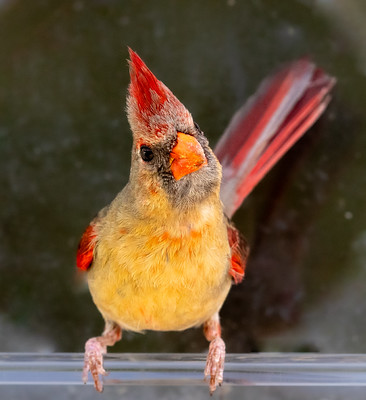
A female Northern Cardinal. Photo by Rob Kleine
If reduced female survival is causing population declines, determining the cause can provide fruitful targets for conservation efforts. In species where females use different locations or habitats during the non-breeding season, these areas could be targeted for conservation or restoration.
The authors’ recommendation that population studies consider sexes separately whenever possible is part of a growing acknowledgement that we cannot assume that male and female birds experience the same threats to the same degree. Many of our field ornithology methods are geared towards observing male birds and that leaves us with a blind spot where females are concerned which can lead to unseen conservation threats and opportunities. Looking more closely at females may require developing new field methods or leveraging existing data, like the MAPS database, in different ways. A recent article, co-authored by Wu in the journal Ornithology gathers considerations and suggestions for how to study female birds in the field; it is part of a special issue on the “Behavior, Physiology, and Ecology of Overlooked Female Birds.” IBP researchers are eager to see what conservation insights and opportunities these new approaches can provide.