

When it comes to documenting vagrant birds, an important consideration is whether or not a bird is the same one seen elsewhere. Generally, a more conservative and, frankly, preferable outcome is to consider two records of a far flung vagrant to be of one rather than two birds. Let's take albatrosses for example. Chatham Albatross is a very rare bird, with a population estimate of only 10-15,000 birds, breeding only on Chatham Island off New Zealand. Thus, when a second-cycle bird was observed over Cordell Bank, off northern California, on 27 July 2001, the prudent thing would be to consider in the same as a first-cycle bird seen there in July-September 2000. One of these rare birds remaining for a year in California, rather than two young (prebreeding) birds making this far. However, we did not have the photographs to consider whether or not it was the same bird and, as such, it is now logged as separate individuals. But by 2008 we had the digital tools to confirm that a Wandering Albatross observed off Rock Point, Oregon, on 13 September was the same individual seen twelve days later off Point Arena, California (see here for details) and, in more recent news, a Waved Albatross photographed off San Luis Obispo county on 23 January 2026 was confirmed to be the same bird documented over Cordell Bank on 5 October 2025, the first of this species to reach North American waters.
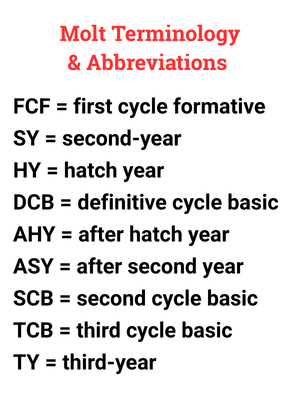
In both of these albatross cases, details among replaced and retained secondaries in the same year confirmed "same bird." In other cases, for example a first-spring (FCF or SY) female Snow Bunting moving from San Diego over 440 miles to Pacific Grove, California in May 2009 (details here) and the first California record of an first-spring Purple Sandpiper moving nearly 600 miles from the Salton Sea to Point Reyes, California, involved details of notches, patterns, and wear on individual feathers. Such comparisons as these can only be made if the birds have not molted all feathers in between observations.
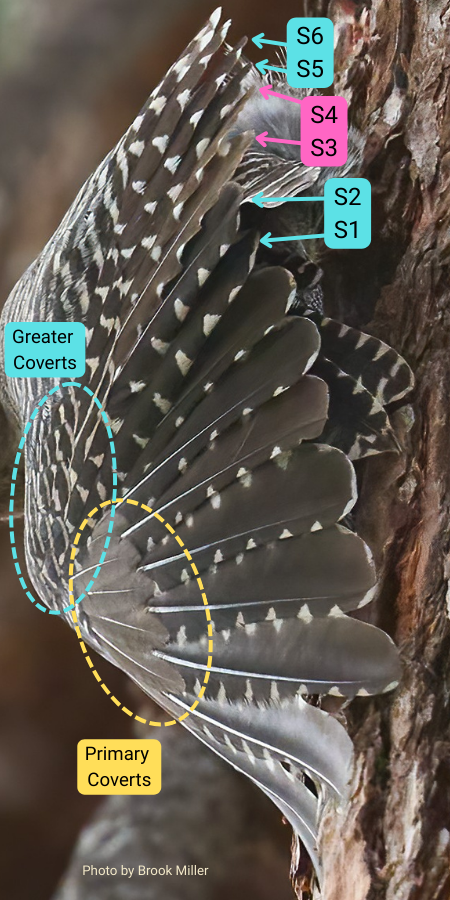
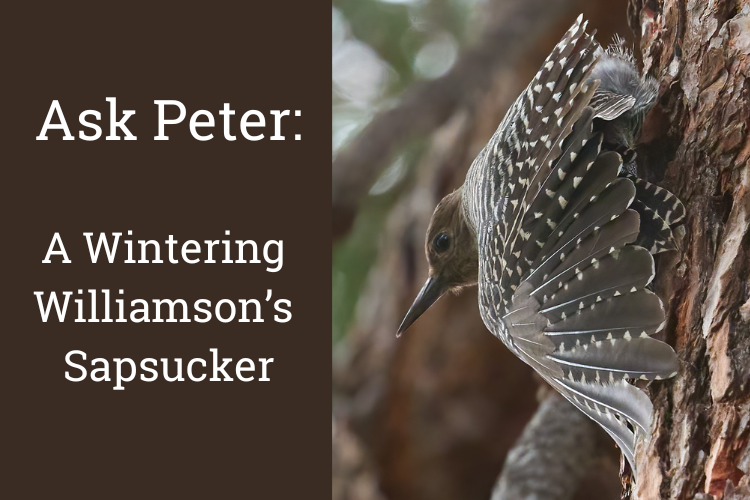
Detail of the third-year Williamson's Sapsucker, Mountain View, California, 26 October 2025. Photo: Brooke Miller (ML644177080)
Another "same-bird" issue involves whether or not a vagrant bird observed one year is the same as one in the same location in past years. For most birds, including all passerines, the prebasic molt is complete, and so we cannot rely on notches and patterns of individual feathers. We can make suppositions based on age, however. There are many cases, for example, of such species as Thick-billed Kingbirds, Greater Pewees, and Grace's Warblers, vagrants in California, seen in one winter as FCFs (HY/SYs), returning the following winter to the same location as DCBs (AHY/ASYs), and thus being considered the same bird. Detailed digital imagery now allows us to age these birds in the field, helping with this assessment (see here for an example of this involving a Grace's Warbler). In other cases, in species without complete prebasic molts, we can sometimes rely on replaced and retained feathers, providing even more support for a same-bird scenario.
A question from Pete Dunten is the subject of this Ask Peter column: "We have a wintering female Williamson's Sapsucker in Santa Clara county, at the same odd location (trees growing in a narrow median strip of a busy road) as a female present here during the winter of 2023-2024. She's hard to spot and could easily have been missed during the winter of 2024-2025. Anyway, someone got excellent photos (eBird Checklist) and if you enjoy this sort of thing, I'd love to know her age."
Do I enjoy these sort of thing? Do birds have feathers? As I retell in this year's upcoming MAPSChat article, molt in woodpeckers and sapsuckers was one of the great avian puzzles to be solved, on the order of the theory of relatively (ok, I suppose only within the tiny bird-molt world, but still...). Woodpeckers do not, in fact, molt all feathers every year and, as we painstakingly learned (see here and here for stops along the way), patterns of retained and replaced feathers during peformative and prebasic molts show broad similarities among all woodpecker species, due in part to ironclad replacement sequences among feather tracts. Sapsuckers, in particular, were especially fun to work out due to their less-complete annual molts than most other woodpeckers, as likely related to their migratory habits (see here).
One of the images of the Santa Clara Williamson's Sapsucker (WISA) from the above checklist, taken on 26 October 2025, is shown above. Blimey, should every photo of a woodpecker in the wild show the wing open like this! (This is why it is important to take in-hand, open-wing images of woodpeckers at your banding stations; see here and here). The two feather tracts to look at in woodpeckers are the primary coverts and the secondaries, both of which molt slowly over multiple years, from both ends toward the center, with the last feathers replaced being the covert corresponding to the sixth primary (p6) and the 4th or 3rd secondary from the outside (s4 or s3). In sapsuckers, it can take up to four or even five years for the last juvenile feathers to molt.
My response to Pete: "Although it'd be nice to see the outermost primary coverts, which I suspect are replaced, the visible primary coverts are all juvenile, which could indicate a bird in its first fall (FCF or HY), second fall (SCB or SY), or third fall (TCB or TY) in sapsuckers in October. The greater coverts are uniformly basic and the secondaries are mixed, with s3 and s4 very worn, juvenile feathers, and the rest replaced basic feathers. S1, s2, and s5 are fresher and look like they were replaced during the last molt (this past summer/fall) while s6 inward were replaced two previous molts ago, in summer/fall 2024. I have full confidence that this pattern confirms a TCB (TY). You can see from this paper on sapsucker molts (here) how perfectly this fits for a TCB now. Cool stuff!"
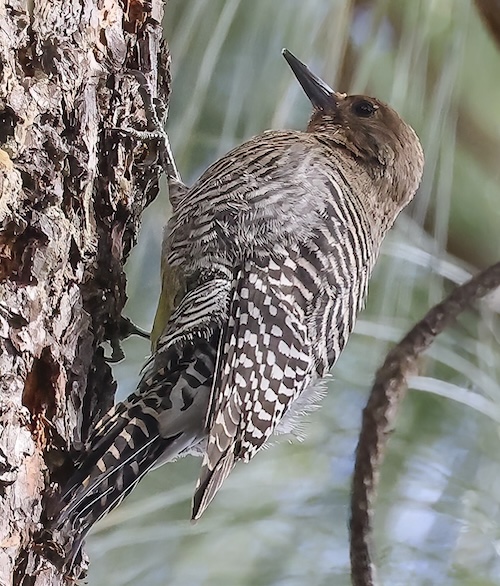
Female Williamson's Sapsucker, Mountain View, California, 6 February 2024. Photo: Thomas Olson (ML614513749).
OK, so this sapsucker being a TCB (TY) in October 2025 makes it at least possible that it is same bird as that of 2023-2024, but this supposition would be strengthened if the earlier sapsucker was known to be an FCF (HY/SY) that winter, having been missed as an SCB (SY/TY) in 2024-2025. For this I turned to the amazing filtering system of Cornell Lab of Ornithology's Macaulay Library, drilling down to WISAs photographed in Santa Clara County in 2023-2024, in order of observation date where I found another 59 images of our subject bird. Note they also had a male WISA in February 2023, with 12 photos. Now, all 71 images are what we typically see of woodpeckers, unlike the photo above, plastered to the side of the tree without any visible primary coverts, and with other wing feathers typically being partially covered by flank feathers. Sigh. But among these 59 photos is the image to the left, taken on 6 February 2024 (eBird Checklist).
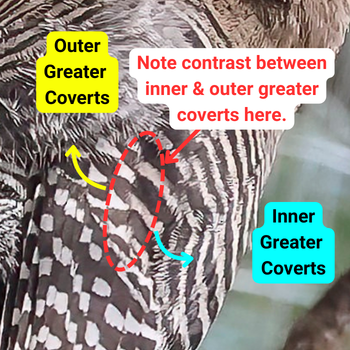
Detail from SY female Williamson's Sapsucker, Mountain View, California, 6 February 2024. Photo: Thomas Olson (ML614513749).
Notice that the outer 2-3 visible greater coverts, above the secondaries and below the overlaying flank feathers, have a slightly different pattern than the inner coverts to the right of these. As in Northern Flickers, the bars are more triangular in shape, not straight across, and these greater coverts also appear more bleached and worn, indicating retained juvenile feathers, contrasting with fresher and more horizontally barred, formative inner greater coverts, and confirming this as an FCF (SY) in February 2024. So, yes, along with location and sex, we can add age as a supporting factor in concluding that this almost assuredly is the same bird, returning for three winters in a row, but having been missed during the second winter. And, yes, it is much better to assume that this vagrant female WISA returned to winter at this same odd and unlikely location, than two female WISAs choosing to do this in different years.
Finally, I couldn't help myself, what of the male in February 2023? Show me a photo, any photo, of any bird, and I immediately try to age it (often before I even care to identify the species). Among the 12 referenced images is the one below, taken exactly one year earlier than the female above. WISAs are unique among our woodpeckers (and maybe among all of the world's woodpeckers) in having very diagnostic sex-specific plumages, beginning even as nestlings. Because they are such non-conformists among Picadae, they were thought by early ornithologists in the mid-1800s to be two different species (see here for the story). So, although the look is quite different, this male also shows uniform wing feathers, except, if you look closely, the s4 is a worn juvenile feather! So, yes, another TCB (TY) in February, even though we cannot see the primary coverts.
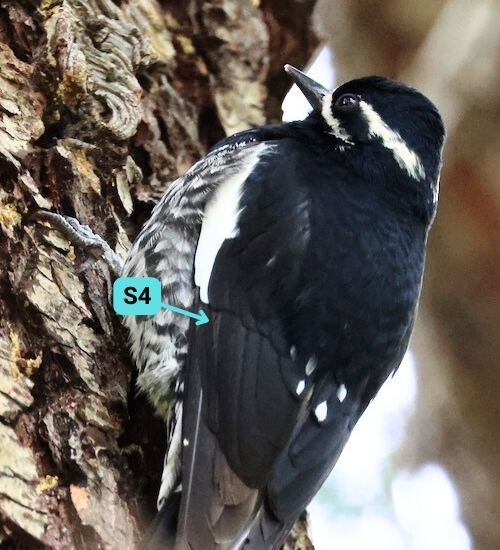
TY male Williamson's Sapsucker, Vasona Lake, California, 6 February 2023. Photo: Jennifer Oliver (ML531171631).
"I thank Pete Dunten for asking this fun question and the photographers for contributing their images to the Macaulay Library and agreeing to their license agreement allowing their use for non-commercial purposes."- Peter Pyle